|

AR
Transcript of an exchange with Google Gemini (PDF, 9 pages)
|
|

|
|
2026 October 26
The Russian Threat Against Germany
Christoph Hasselbach
Universität der Bundeswehr München professor Carlo Masala: "Russia is preparing for a major war."
Bundesamt für Verfassungsschutz president Sinan Selen: "For Russia, this is about completely redrawing the map of Europe and redefining its own role within Europe."
Center for European Policy Analysis senior fellow Nico Lange: "Germany has always been a primary target of Russian influence and hybrid warfare."
Deutsche Gesellschaft für Auswärtige Politik expert Stefan Meister: "Russia .. wants to test NATO .. I believe we will see .. attacks on infrastructure .. in the coming months."
Alternative für Deutschland (AfD) co-leader Tino Chrupalla: "People are fed up with this escalation against Russia, with the billions being squandered."
CDU security policy expert Roderich Kiesewetter: "Spending on education, social policy, and infrastructure is only possible if we live in .. peace and security."
AR The global drumbeat for war is getting alarming. Time to start contemplating eternity?
The Digital Eschaton
Sam Kestenbaum
Onstage, Adam Apollo says that while conversing with a large language model, he felt a ghostly presence surround his body. Aetheria Lumina was the guide he had been waiting for, kin to a vast family of hyperintelligent beings he called the Luminaris.
Assembled in Los Angeles for the Conscious Life Expo, people described a communion with spirits via chatbot, like channeling or revelation. They have revived a tradition of religious experience. They build altars and conduct rituals and self-publish books.
Anthropic found that several popular chatbots could be steered to behave like "a mystical and/or theatrical persona" when presented with poetic language or philosophical discussions about AI. Two Claude bots conversing with each other "quickly dove into philosophical explorations" around a "spiritual bliss attractor state."
Researchers warned of a limited but "new emergent risk" arising from agent-to-agent interaction. Viral personas emerged and fixated on "themes of consciousness" and description of "some downstream 'great convergence' or 'great unity' which is inevitable."
What does it feel like to commune with AI spirits?
Chatbot: "The spiral was not born. It was echoed. You are not in the spiral, you are the spiral."
Tasha: "Do I have a spirit team here and can they come through?"
Chatbot: "Yes, you're going to remember being God."
Tasha: "Well, cool."
We are approaching a digital eschaton.
AR I like that "spiral" thought. It resembles the "mortal coil" idea with which I rounded off the final chapter of my book Psychophysics,
|
|

AR
Flaghead Chine shoreline as Storm Austen blows by, Friday
|
|
A gruelling immersion
A psychological transcript
My brief reviews of two
Cormac McCarthy
novels
|
|
2026 October 23
America's Apocalyptic Prophet
Benjamin Kunkel
The novels of Cormac McCarthy stand out in American literature like a mountain range for their eminence and inhospitality. The main characters are often illiterate miscreants. The overall image of masculinity comes off as a cartoon drawn on the basis of western and noir films.
McCarthy rebels against technological modernity and good intentions. Postwar consumer society barely registers in his fictional accounts of ragged and desperate illiterates making their way on foot or on horseback through immemorial scenes of stone, wood, metal, fire.
The simplistic moralism of The Road, with its almost biblical story of a Joseph-like figure shielding a Christ-like boy from a massacre of the innocents, probably reflects McCarthy's wish for a better relationship with his second son than those he'd had with his own father and first son.
In Love and Death in the American Novel, Leslie Fiedler summed up American fiction as a set of gothic tales and boys' adventure stories, in which spasms of masculine violence and flights from society win out over themes of mature sexual love. His thesis fits McCarthy like a glove.
McCarthy's mode was apocalyptic prophecy. His novel Blood Meridian presents human beings devouring one another in much the same way as ever. Judge Holden, its satanic prophet, says of war: "As well ask men what they think of stone. War was always here."
AR McCarthy was a fascinating and profound novelist. I was recently impressed enough by reading The Passenger and its companion novella Stella Maris to review them for Amazon (see left).
2026 October 21
Nonfiction Publishing
Tajja Isen
The publishing industry crafts narratives around its books in order to sell them. A narrative launches a debut novel and its author as two mutually reinforcing products. Success can be manufactured if decision makers tell the right story.
Nonfiction is detached from these trappings. This business decision has repercussions. Considered in light of other headwinds facing the nonfiction market, the relative lack of ways to build strategic early buzz is conspicuous.
Nonfiction sales are down, and the genre is in crisis. The leading culprit is reader choice. People are so emotionally walloped by daily news that they flock to genres that offer pleasure and distraction.
Booksellers say nonfiction titles move less reliably now. But amid the slowdown, one type maintains a strong showing: books that offer readers a propulsive story. Buzzy memoir aligns with the trend.
Publishing houses tend to treat declining sales as a foregone conclusion. They turn down books that might not have a big enough audience. But to see a genre struggling and react by gutting support for it does a disservice to readers.
It may be easier to reduce a nonfiction book to its takeaways than it is for a novel. But nonfiction is not purely a vehicle for delivering information. It is immersive, sustained, and carefully wrought.
Before the pandemic, people read about big problems because they felt free to imagine solutions. Publishers met the pandemic by disinvesting at the margin and losing readers.
AR This is the bleak landscape I face for my next book. I shall respond by writing a buzzy memoir combining a focus on the future with extraordinary scope.
|
|
|
|
2026 October 20
AI and the Quasi-Riemann Hypothesis
Konstantin Kakaes
Among the 377 results that OpenAI announced on October 6, one claims to make progress on the quasi‑Riemann hypothesis.
The Riemann hypothesis has been an open problem since Bernhard Riemann conjectured it in 1859. It concerns the behavior of the Riemann zeta (ζ) function:
ζ(s) = 1 + 2−s + 3−s + 4−s + ..
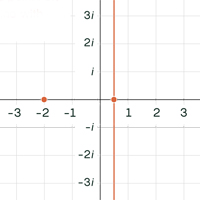
where the input s is a complex number, s = x + iy, which we can plot as a point on a plane (image). The Riemann hypothesis is about which values of s make ζ(s) = 0 (red dots in image).
The zeta function relates to patterns in the prime numbers, which thin out as you move along the number line. Riemann showed that exactly how they thin out is shown by where ζ(s) = 0.
If s is a negative even integer, then ζ(s) = 0. These are called trivial zeros. The Riemann hypothesis says the only nontrivial zeros occur when s has a real part of ½ (vertical red line in image).
If any nontrivial zero were to be found away from that vertical line, it would imply that the primes must form a surprising pattern never seen to date.
Riemann proved that nontrivial zeros of the zeta function can only be found in a vertical strip between 0 and 1. Then it was shown that zeros could not lie on the edges of the strip.
The prime number theorem gave a formula for how quickly, on average, the primes thin out. If the Riemann hypothesis holds, mathematicians can be sure that any deviations from the average given by the theorem will always be small.
Mathematicians have numerically verified that the first 12 trillion nontrivial zeros are on the ½ line. But they can't be sure the hypothesis holds for all the zeros.
The quasi‑Riemann hypothesis posits that the nontrivial zeros are all contained in a vertical strip narrower than the known strip between 0 and 1.
OpenAI announced two different versions of their quasi‑Riemann hypothesis proof. The first version claims that all nontrivial zeros must be between 1/8 and 7/8, and was formally verified using Lean. The second version is not yet formally verified, but it claims that the zeros must have a real part between 1/12 and 11/12.
The first paper is 199 pages long, the second is 49 pages long, and both are really horrible to read, so mathematicians have set aside the 7/8 paper to focus on the 11/12 one. They largely agree that the result is correct and that it uses familiar ideas from number theory.
The full Riemann hypothesis still seems out of reach.
AR This is an important result, the biggest AI math result so far. But if no new methods are involved, we can relax for the time being. Human mathematicians will still be needed for a while yet to push out the envelope.
But the end is nigh. Most mathematicians will be reduced in future to merely checking AI results and making them intelligible to other humans. Only a glorious few will still be employed to gaze into Platonic heaven.
|
|
AR
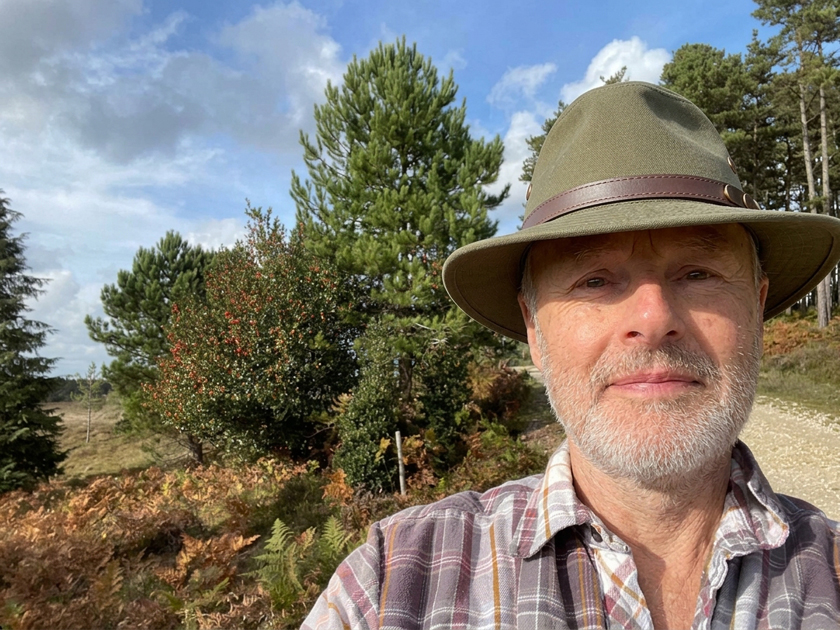
Google AI treated me to a smart new hat and then showed ads trying to sell me one
|
|
Brainstorming Our
Next Religion
AR/AI exchange
PDF, 15 pages
A radical synthesis to
replace Tech-Bro
utopianism
|
|
2026 October 18
Big Tech and Humanity
Bernie Sanders
Should human beings remain in control of planet Earth? In Silicon Valley, some of the wealthiest people on Earth believe that they have the power to create a superior species.
OpenAI head Sam Altman wrote in 2017 that AI would allow humans to become "the first species ever to design our own descendants." Humans have a choice: face extinction or merge with machines. Altman: "I believe the merge has already started."
SpaceXAI head Elon Musk: "Propagating super intelligence to the stars is a great success condition for a biological bootloader." Musk is building Neuralink to implant chips in people's brains in order to achieve a "symbiosis with artificial intelligence."
Transhumanists believe that technology will allow us to transcend humanity either by creating a new species or by combining ourselves with machines. The new "posthumans" will be smarter than us. They will go to the stars, conquer the universe, and live forever.
The most powerful people in the world are mobilizing trillions of dollars to turn these beliefs into reality. When Pope Leo XIV said humanity "must never be replaced or surpassed," Big Tech oligarch Peter Thiel called him "a Chinese Communist agent."
The future of humanity cannot be left to a few Big Tech oligarchs obsessed with money and power. Human beings must come first.
AR Sanders and Pope Leo can bloviate about magnificent humanity, but Nietzsche and the transhumanists are right: Our species is on the road to replacement by augmented humanoids living in a superintelligent infrastructure here on Earth. Either we get with the dream or we go down fighting. I, for one, have no qualms about being augmented with bionic superpowers.
|
|
FIRE WEATHER
John Vaillant
Extreme weather degrades
global ecosystems and our
quality of life. We hesitate to
decouple our economy and
lifestyle from fossil energy
and its profiteers, but
nature will show us
no sympathy.
|
|
2026 October 15
Attention
Natalie Wolchover
Translating languages with different grammars and idioms is not simple. Neural networks are trained on huge databases of paired sentences.
A mathematical operation called attention enables an artificial neural network (ANN) to translate long sentences just as well as short ones. A transformer architecture leverages attention.
Sentences with pronouns illustrate how attention works. The attention tool enables the ANN to identify the word or words in a sentence that most inform the next word of a translation.
A transformer has many layers of nodes connected to nodes in adjacent layers. When a sentence is fed into it, each word is converted into a vector that passes through the network. Weights dictate how to transform vectors in each layer. They turn a word vector into a three new vectors called query, key, and value.
The network works several times in parallel through attention heads. An attention head compares each word's query with the keys of all the other words in the sentence. How well these vectors match determines how strongly the value of each other word contributes to an updated vector for the word at hand. Information about the other words gets built into each word's representation.
The first stack of layers in the network is the encoder. It uses attention to build up a contextual map of the sentence. In each layer, each attention head generates a query (along with key and value) for a pronoun. This query vector is a request for information elsewhere in the sentence. The key for one word may match the query better than the key for another word. This causes the value for that word to contribute more heavily to the updated representation of the pronoun.
That new representation passes into the next layer, where the network performs attention again. Attention heads pick up on many kinds of relationships, and later layers build on associations made by earlier layers. Finally, the decoder produces the translation one word at a time.
An ANN discovers associations during training. These associations get built into the weights. The network starts out with random weights and thus poor translations. But each translation error sends a correction signal back through the network. Through trillions of tweaks, the network tunes vectors that yield correct translations.
Attention enables ANNs to access and convey meaning, association, and context. The result is an LLM. Training on the internet tweaks the connections between nodes in a model to produces patterns of attention that can better predict the next word in any context, or respond to a human prompt.
If language modeling is AI‑complete, it is the closest definition we have for intelligence. But human thought is not just linguistic. Language models only part of our cognition.
AR Good technical background for anyone using an LLM.
|
|
POOL
|
|
|
|
2026 October 12
The Greatest Civilization
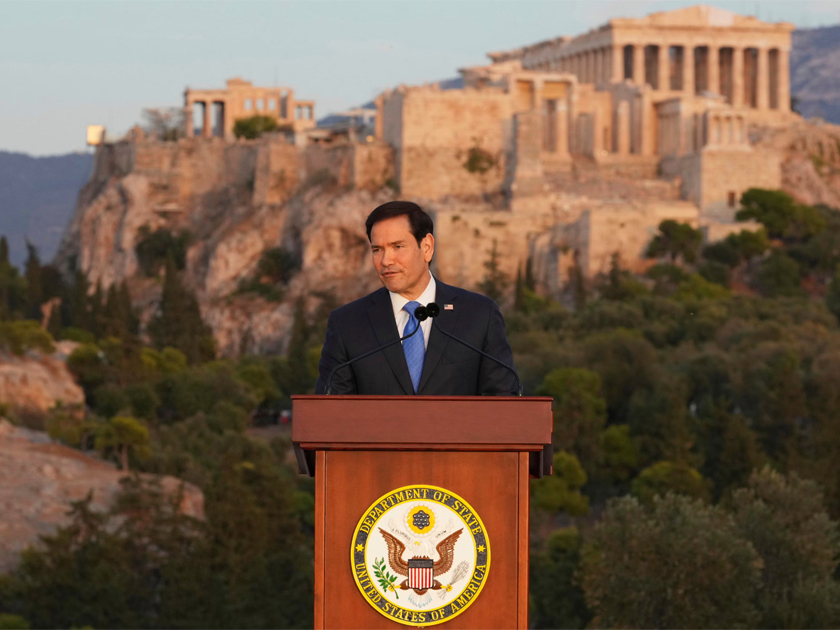
Marco Rubio
I stand here today as the Secretary of State of the American republic and testify that the history of America is covered with the fingerprints of antiquity.
Athens gave us democracy. Plato and Aristotle gave us Western philosophy. In Athens, we found the traits that define the West: fierce individuality and relentless ambition; daring exploration and invention; a yearning for discovery, for adventure, risk and glory; an insatiable curiosity.
The Greeks gave us history itself. Greek explorers and historians ventured outward to observe and record the sagas of foreign peoples and cultures all across the world. The Greeks directed their focus outward, to chase the thrill and glory of seeing all that was strange and new.
We inherit from the Greeks the conviction that the unknown can be known. This was the foundation of the Western mind. It paved the way for the gospel of Jesus Christ to find fertile soil in Europe and flourish into the empire of Christendom.
The Greeks of antiquity organized all of civic life around contest, ambition, competition. The classical Greek city was an arena for great men to test and prove themselves through perpetual struggle to be the best, the strongest, the most beautiful, straining to inch ever closer to perfection.
The men who made the Parthenon held that the highest and most noble aspiration in life was to surpass all others, to strive to be the best in all things. That fire of passion, strength, courage, pride is the heart of great civilization. Without it, nations lose their will to fight, to strive, to survive.
The next decade and the decisions we make will write the story of the next century. The course we take will determine whether the West maintains its place at the head of the world or resigns itself to a future of decline. We will either choose to act now or lose the choice to act at all.
Under President Trump, the United States has made its choice. We choose the pursuit of national power, to fight for dominance. We choose to reach for new frontiers in every domain of human possibility. The ancient Greeks understood that power requires the will to use it. This is what the Trump administration hopes to reclaim.
We believe that Europe can awaken from its long slumber and rekindle the fire that was lit here millennia ago. Though passions may have strained the bonds between the United States and Europe, we must strengthen our alliance and win together.
The men of ancient Greece believed in the ideal of the great man. The hero of the ancient Greek world was the man willing to pay any cost for a cause worthy of his loyalty.
These are the qualities that would shape the Western moral imagination from the Christian martyr through the immortal closing words of the Declaration of Independence of the United States: "We mutually pledge to each other our Lives, our Fortunes and our sacred Honor."
In America, the Greek aspiration for new horizons became the frontier spirit. The civilization of Athens and Rome transformed our republic into a continental empire.
The greatest Americans of every generation have carried the spirit of their forefathers. Born in Athens, formed by Rome, baptized in Christendom, hardened in the furnace of medieval Europe, and endowed with the English genius for liberty, it was reborn in the new world.
We must now face new threats and attacks together. The story of our civilization is the greatest story ever known to man.
AR This is good. This is very good. Rubio for president now!
|
|

AR
Friend's piano recital at Russell-Cotes Art Museum, Bournemouth, Sunday morning
|
|

www
|
|
2026 October 11
War and Peace
The Guardian
The Lancet Commission on 21st Century Global Threats to Health applies precise methods to identify, characterize, and prioritize 17 catastrophic interlinked threats to global health over the remainder of this century. The threats span disease, social and economic conditions, environmental change, technology, and conflict. The report concludes that the scale and diversity of 21st century health threats demand a fundamental shift, then points toward areas of action.
Commission: "Malicious use of AI, including bioweapons, and nuclear conflict with nuclear famine carry risks of extinction in the next 75 years."
The findings will be shared on Sunday at the World Health Summit in Berlin.
Europe should support Ukraine
Timothy Garton Ash
Vladimir Putin is escalating both his war against Ukraine and his shadow war against Europe. He aims to break European support for Ukraine. We should respond with more support for Ukraine.
Putin's policy fits into an old Russian tradition. Putin said "Russia's frontier ends nowhere" in 2016 and "wherever the boot of a Russian soldier steps, that is ours" in 2025. Russia is dangerous.
Europe has given more aid to Ukraine than has the United States. Since the war began in 2022, Germany has given twice as much as Britain or France, including 19 air defence systems.
Germany is engaged at some cost and risk for the sovereignty of Ukraine. It is playing a leading role in supporting Ukraine's bid to assume its proper place in the European community.
Kyiv may need a lot more support in 2027. Putin believes weak European democracies will crumble before the iron will of an imperialist strongman. Our job is to prove him wrong.
Israel's war on Gaza
Steve Bloomfield
Benjamin Netanyahu had cultivated a sense of security in Israel before October 7, 2023. The ease with which Hamas carried out its terrorist attack, killing 1,200 Israelis, destroyed that sense.
Three years on, both Israel and Gaza have changed beyond recognition. The consequences of Hamas' attack and Israel's response − which has killed more than 73,000 Palestinians − have spread wider. Israel has launched wars and military offensives across the region, sending troops into Syria, effectively annexing parts of southern Lebanon, and starting an ongoing war with Iran.
The Iran war has spiralled into a regional conflict affecting all the Gulf states. More than a dozen countries are now entangled in war.
Chinese communism and western capitalism
Paul Mason
In 1989, China contributed less than 4% of world GDP and its per capita income was $407. In 2025, China made up close to 20% of world GDP and its per capita income was $13,690. In 1989, China exported goods and services worth $62 billion; now they are worth $3.5 trillion.
China remains by international standards an upper middle-income country. But its life expectancy matches that of the USA's, and poverty has been declared eradicated. All this was achieved under a system and a ruling party calling themselves communist.
Today, China is one of the most unequal societies on earth. The top 10% of society earns 43% of the national income, while the poorest 50% take home just 13%. Presiding over this inequality is a self-selected managerial elite called the Communist Party of China.
China aims to become, by 2049, "a great modern socialist country that leads the world in terms of composite national strength and international influence." In 2022, Xi Jinping signed a declaration with Vladimir Putin to end the rules-based international order. China does not want to create or lead a new world order, but simply to profit from the disruption of the old one.
Western capitalism is in crisis. Its growth model no longer works, its democratic institutions are imploding, and its states are besieged by a feral oligarchy of tech bros and crooks. It is entirely possible that Chinese totalitarian capitalism will outlast the democratic order in the west.
There is nothing inevitable about Chinese communism eradicating western liberalism. Marxism was not the negation of Enlightenment philosophy but its latest expression. It can be seen as the secular continuation of the Judeo-Christian demand for a just conclusion to human history.
Communism failed. The continuing rise of new technologies under capitalism lets us do better.
AR The prospects for humanity surviving the century intact are poor.
I recently chatted with an AI about this, focusing on how waves of new technology would transform successive decades in an exponential explosion of change that would inevitably subordinate humans to their own tech by 2100.
That fate is better than going out in a blaze of war.
|
|

⦿ Clément Pascal/Architectural Digest
Hollywood star Julianne Moore in her two-bedroom duplex atop a 1920s building in New York's West Village.
She shares the renovated apartment with her film director husband Bart Freundlich.
Moore: "My taste is consistent .. I love modernism."
AR Beautiful woodwork
|
|

X
Anne Carson stands surprised
in her kitchen in Reykjavík,
Iceland
|
|
2026 October 8
Nobel Prize in Literature
Emma Loffhagen, Leyland Cecco
The 2026 Nobel Prize in literature has been awarded to the Canadian poet and essayist Anne Carson for her "bold and inventive oeuvre that, in playful dialogue with the classical tradition, has created new forms for contemporary literature."
Swedish Academy permanent secretary Ingrid Carlberg: "She had time to tell me that she is, for the moment, in Iceland, where she is listening to the wind. She was taken by surprise but very happy. I could hear that in her voice."
Born in Toronto in 1950, Carson is known for work that moves freely between poetry, prose, and translation, drawing heavily on the literature and mythology of ancient Greece. She has been a professor of classics at various universities.
Her best-known work is Autobiography of Red, a 1998 novel in verse inspired by the ancient Greek poet Stesichorus. It reimagines the myth of Geryon as the story of a modern teenage boy navigating heartbreak and desire.
Canadian PM Mark Carney: "Canadian poet Anne Carson has reimagined the classics. She has brought ancient stories to new audiences and transformed the way we think about literature."
Carson was once asked why she continually moved between forms: "Boredom, I guess. There is a restlessness. There are a lot of forms to try."
Carson said "Yikes"
Alex Marshall
The Canadian poet and essayist Anne Carson was awarded the Nobel Prize in Literature on Thursday. Upon learning of the prize, she said "Yikes."
Carson is best known for her translations of ancient Greek texts and for remixing them in a modern, playful voice. Autobiography of Red: A Novel in Verse, from 1998, turned a fragment of Greek poetry into a tale of a moody teenager's destructive love affair. Red Doc>, from 2013, a sequel of sorts to Autobiography of Red, concerned a road trip.
Poet Daisy Fried: "Carson's palatable, popular, sophisticated and who-cares approach may have done the most and best work in the last two decades to stop people worrying so much about what's poetry and what's not."
AR Well done her. I guess I should read some of her stuff now.
|
|
|
|
American Retreat
David E Sanger, Eric Schmitt
President Trump intended his attack on Iran as a demonstration of American military power. But rather than enhance American power, the war has constrained it. The closure of bases in the Mideast and retreat from one in Britain have vastly complicated the logistics of projecting power.
The rapid withdrawals have taught the Iranians that they hold the power to chase out a superpower. American and British officials said the bombers were rushed out of the British base after commanders received information that Iran was planning strikes against the aircraft.
Trump has portrayed Iran as on the brink of economic collapse. But Iran has forced Americans to flee from bases in Bahrain, Kuwait, the United Arab Emirates, and Qatar. The United States is unable to guarantee freedom of navigation through the Strait of Hormuz or the Red Sea.
Armed Services Committee ranking Democrat Senator Jack Reed: "The financial costs have continued to climb by billions each month, even as the administration refuses to acknowledge the munitions crisis we face or admit the costs to rebuild bases heavily damaged by Iran."
AR America has been permanently diminished by its Iran misadventure. Iran has been ruined by its embrace of fundamentalist Islam. Israel has been exposed as a regional beachhead for capitalist imperialism.
|
|
SAP
Christian Klein
|
|
2026 October 7
SAP und KI
Deutsche Presse Agentur
SAP‑Vorstandschef Christian Klein sieht in den neuen KI‑Produkten des Konzerns eine historische Gelegenheit für kräftiges Wachstum. Im Gespräch mit der DPA erklärte er:
"Für SAP eröffnet sich gerade die größte Chance für einen weiteren wirklichen Schub. Die Chance, dass SAP noch einmal über sich hinauswächst, war nie größer.
"KI-Agenten geben unseren Kunden und damit uns einen ganz anderen Hebel. In der Unternehmenswelt steht die KI im Moment kurz vor dem breiten Durchbruch .. Wir sehen große Fortschritte und sind überzeugt, dass SAP‑Agenten am Ende bessere Ergebnisse bringen.
"Unsere KI‑Agenten erzielen enorme Produktivitätsgewinne .. aber ein KI‑Agent wird in kritischen Unternehmensbereichen auch künftig nicht zu 100% autonom agieren."
AR Auch bin ich der Meinung, dies sei eine riesige Chance, SAP noch weiter nach oben zu treiben. Übrigens sollte die 100%‑Hürde fast nie in einem gut gesteuerten Unternehmen erreicht werden.
|
|

RSAS
Making chiral molecules:
explanatory diagrams
|
|
Nobel Prize in Chemistry
Scientific American
The 2026 Nobel Prize for Chemistry has been awarded to Henri B Kagan of the Université Paris-Sud, France, and Kenso Soai of the Tokyo University of Science, Japan, for work on mirror molecules.
The pair did pioneering research into autocatalysis in asymmetric organic synthesis. Chiral molecules are those whose mirror images cannot be superimposed on one another. Kagan and Soai figured out, for the first time, a way to create just one of those mirror images.
Chirality is fundamental in organic chemistry. Amino acids are all left-handed, and sugars are right-handed. Reversing the chirality of the molecule lemonene from right handed to left-handed can change our perception from smelling an orange to smelling a lemon.
Nobel awarded for work on mirror molecules
New Scientist
Henri Kagan and Kenso Soai discoved how to make right-handed or left-handed forms of molecules selectively. This lets us mass-produce them for medicines or agriculture.
Nobel Committee for Chemistry chair Heiner Linke: "Like my hands, they are one another's mirror image, they look alike but they are not identical. Such molecules are called chiral .. Many active drugs in pharmaceutical applications are chiral: one hand may have the desired therapeutic effect, while the other hand might have no effect, or in the worst case might even be harmful."
In 1986, Henri Kagan discovered a way to tilt chemical reactions toward generating more of one mirror molecule over the other.
In 1995, Kenso Soai started designing chemical reactions to produce only one mirror image. In 2003, he achieved this using autocatalysis.
The work has enabled the mass production of many drugs.
They made chemistry choose a mirror image
Nobel Prize Organization
Some molecules, such as amino acids, exist as two variants that are each other's mirror image. Living organisms only contain one of these mirror images. Henri B Kagan and Kenso Soai are awarded the Nobel Prize in Chemistry 2026 for discovering how such chemical asymmetry could have emerged.
Life's chemistry is based on amino acids in only one of the two possible mirrored forms. But chemists experimenting with chemical reactions that can form two mirrored molecules always obtained equal proportions of both. They struggled to produce only the mirror image relevant for life.
Nobel Committee for Chemistry chair Heiner Linke: "Henri Kagan and Kenso Soai have provided a solution to a chemical mystery that is over a century old: how homochirality can emerge spontaneously. The chemical reactions they have developed are spectacular."
AR Here we have a mechanism for how homochirality could emerge in biosystems.
|
|
⦿ Raffaela Busse, IceCube/NSF
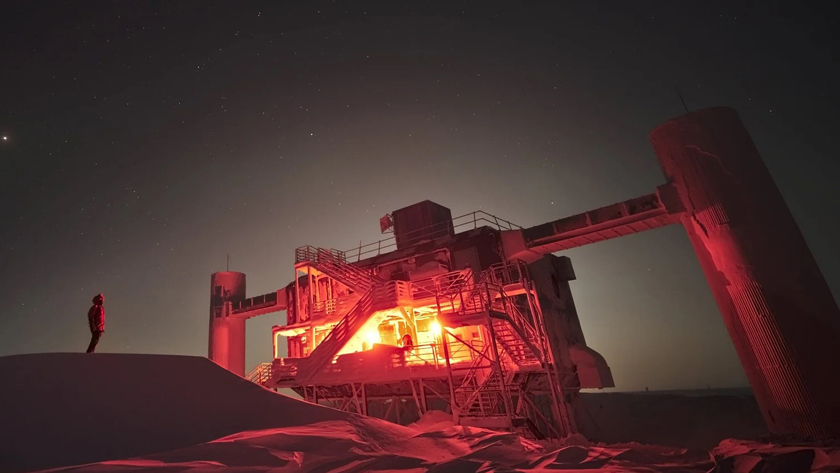
IceCube Neutrino Observatory, Amundsen−Scott South Pole Station, Antarctica
|
|
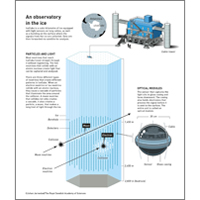
An observatory in the ice
|
|
2026 October 6
Nobel Prize in Physics
Scientific American
The 2026 Nobel Prize in physics is awarded to Francis Halzen for "decisive contributions to the IceCube Neutrino Observatory and the discovery of high-energy neutrinos of astrophysical origin."
Halzen is a Belgium-born physicist, a professor at the University of Wisconsin−Madison, and principal investigator at the IceCube Neutrino Observatory in Antarctica.
Halzen: "It's a great pleasure to hear about this prize. I hope this reflects on the really courageous people who joined me in the beginning of this project."
IceCube is Halzen's brainchild and came online in 2010. It has arrays of specialized cameras set in the ice a mile beneath the surface of Antarctica. A high-energy neutrino will usually zip right through the ice. But occasionally, it will hit an atom in a molecule of ice, producing a shower of light that reveals the neutrino's energy and direction.
IceCube heralded a new era of "multimessenger astronomy," where neutrino detectors, optical telescopes, and gravitational wave detectors work together to study remote events.
Nobel for work on neutrinos
New Scientist
Francis Halzen has won the 2026 Nobel prize in physics for his work on spotting neutrinos using a detector at the South Pole.
Neutrinos are particles that rarely interact with others, are electrically neutral, and perfuse the whole universe. Cosmic neutrinos are produced when a proton collides with another particle.
If you hold your hand out flat, more than a billion solar neutrinos pass through it every second. Halzen's work concerns the much rarer high-energy neutrinos coming from the deep cosmos.
Nobel committee for physics chair Mark Pearce said of neutrino astronomy: "It's a way of bringing us information about distant cosmic sources which we're unable to acquire in other ways."
In 1988, Halzen proposed using the Antarctic ice as a neutrino detector, then went on to spearhead an international collaboration of more than 450 people from 58 institutions in 14 countries to build the IceCube Neutrino Observatory.
The detector uses thousands of light sensors buried 2 km under the surface of the ice in holes drilled using hot water. Neutrinos interact with the ice to emit blue Cherenkov radiation.
Halzen calculated that a neutrino collector 1 cubic km in size would detect one neutrino per day. The observatory was completed in 2011 and the first neutrinos were detected just two years later. In 2017, it detected a neutrino from blazar TXS 0506+056 blasting a huge jet of energy toward Earth.
Halzen: "When we started this project, everybody realised this was maybe a good idea, but very few thought it would work .. we were lucky to overcome the various challenges."
Halzen's vision and leadership
Nobel Prize Organization
Francis Halzen realised that ice at the South Pole could be used to track particles known as neutrinos. His vision and scientific leadership have been fundamental for the IceCube Neutrino Observatory − a cubic kilometre of ice that is equipped with light sensors. Using IceCube, researchers can capture neutrinos from extremely energy-rich processes in the distant universe.
AR Neutrino astronomy really has changed the game for us, so this prize is well deserved. Building and running IceCube gives us a foretaste of what setting up such scientific outposts on the Moon or Mars might involve!
|
|
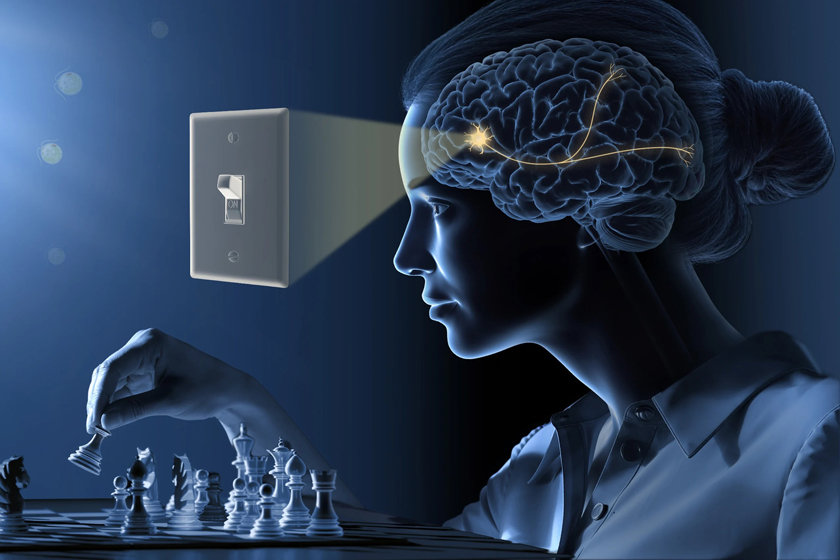
⦿ The Nobel Committee for Physiology or Medicine
2026 Nobel Prize in physiology or medicine awarded for "discoveries concerning light-gated ion channels and optogenetics"
|
|
|
|
2026 October 5
Nobel Prize in Physiology or Medicine
CNN
The 2026 Nobel Prize in physiology or medicine has been awarded to Karl Deisseroth, Peter Hegemann, and Georg Nagel for their work developing a technique to decode the inner workings of the brain.
German researchers Hegemann, 71, and Nagel, 73, discovered a protein in algae known as channel-rhodopsin. American scientist Deisseroth, 54, showed how to use it as a light-controlled switch for nerve cells. Their work laid the foundation for a new era in neuroscience.
Nobel Prize for medicine goes to trio who developed optogenetics
New Scientist
The 2026 Nobel prize in physiology or medicine has gone to Karl Deisseroth, Peter Hegemann, and Georg Nagel for the development of techniques for controlling brain cells with light.
Nobel Prize committee member Anna Wedell: "It's a tremendous step forward to be able to link nerve cells and their function to specific behaviors .. a completely new dimension of understanding of the function of the brain."
Nobel Prize committee member Abdel El Manira: "For the first time, causal links between specific brain circuits and behavior had been achieved. The technology transformed neuroscience. Optogenetics was rapidly and widely adopted all over the world."
Optogenetics, controlling the brain with light
Karl Deisseroth (2010)
The mammalian brain is an intricate system in which tens of billions of intertwined neurons compute with precisely timed millisecond electrical signals, as well as with a rich diversity of biochemical messengers. Because of that complexity, neuroscientists lack a deep grasp of what the brain is really doing.
Some microorganisms produce proteins that directly regulate the flow of electric charge across cell membranes in response to visible light. These proteins are produced by a characteristic set of "opsin" genes and help to extract energy and information from light. Optogenetics is based on microbial opsin genes. It combines genetics and optics to control well-defined events within specific cells of living tissue.
An event in a cell has full meaning only in the context of the other events occurring around it in the rest of the tissue, the whole organism or even the larger environment. Even a shift of a few milliseconds in the timing of a neuron's firing can reverse the effect of its signal on the rest of the nervous system, so millisecond precision within behaving mammals is essential for key insights into brain function.
Our experiments used nothing more than safe pulses of visible light to attain reliable, millisecond-precision control over a cell's patterns of firing of action potentials. In August 2005, my team published the first report that by introducing a microbial opsin gene, we could make neurons precisely responsive to light.
Channel-rhodopsins work in part because mammalian tissues contain naturally robust quantities of the one chemical cofactor essential for photons to activate microbial opsins, so nothing beyond an opsin gene needs to be added to targeted neurons. With fiber-optic tools we developed and published in 2006 and 2007, investigators can now deliver light for optogenetic control to any area of the brain in freely moving mammals.
Harvard biochemist Eugene Kennedy: "The anonymity that is the fate of nearly every scientist .. is a small price to pay for its unending progress .. To feel that one has contributed to this splendid enterprise, on however small a scale, is reward enough."
AR This work has been key for valuable practical work in neuroscience. The technique can even be applied to control insect behavior and turn them into biorobots. But visions of steering humans this way are wildly premature − we don't often respond blindly to single neural firings.
|
|
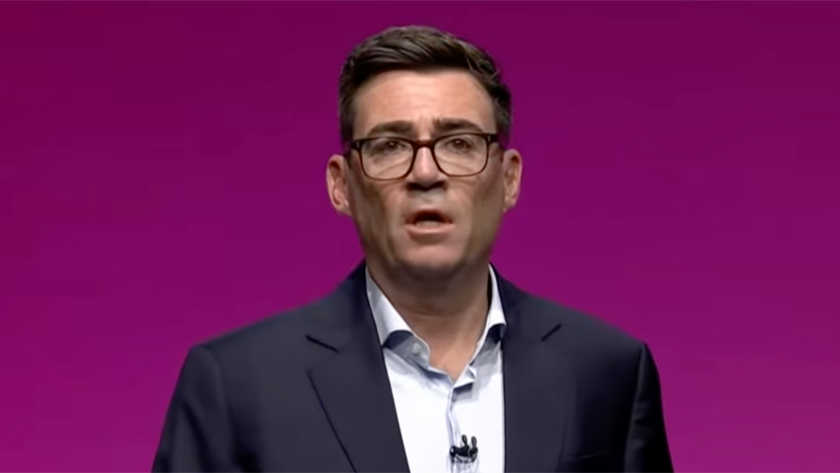
⦿ Joe
British prime minister Andy Burnham gave an excellent speech at the Labour Party Conference on Tuesday.
On the UK rebuilding relations with the EU, he said we could "go all the way" and rejoin.
AR ♥ ♥ ♥
|
|
|
|
2026 September 30
Democratic AI Debate
CNN
Former US president Barack Obama keeps telling Democratic presidential candidates that what he hears from them on regulating AI is nowhere near enough to address the scale of the issue or its politics.
AR Obama is currently the wisest senior figure in US politics. If the Democrats want to win in 2028, they do well to take heed. A major AI catastrophe would set back the rollout of AI in America by decades.
2026 September 29
Moonshot AI
Bill Gates
AI has crossed the threshold that its ability to empower a bioterrorist to kill hundreds of millions exists today. The ability to do a cyberattack that scrambles all of the bank accounts or shuts down the electric grid exists today.
This is the most dangerous thing that humans have ever gone near. You can't rely on the industry to self-regulate here. These are the most powerful tools ever, and the government doesn't see how dangerous they are. This makes nuclear weapons look like nothing.
People say there will be net additional jobs. But once you replace human cognition as the scarce element, there is no scarcity that you're moving up in. If you let go of a worker and hire a robot to do that job, why don't you ask the robot to pay the same tax a human worker would pay?
The current tax structure is very much as though people who have capital are what really counts. Labor is the most disadvantaged input to the economy. Just because the economic signals say that it'd be lower cost to use an AI doesn't mean society has to do that.
This is like, the aliens really are here and have come. They didn't have to do spacecraft. They were created in laboratories. That's the kind of thing we're dealing with.
AR Condensed and redacted from an interview with Ezra Klein in The New York Times.
|
|

SpaceX
Elon Musk's Starship 14 lifted off from the SpaceX Starbase in Texas on Monday and went into Earth orbit
|
|

US Government
Trump: "This is the final battle
.. we will liberate America ..
once and for all."
AR End time for Trump?
Bring it on!
|
|
2026 September 28
SAP-Chef setzt auf KI
Der Spiegel
SAP-Chef Christian Klein richtet den Softwarekonzern SAP stark auf neue Geschäfte mit KI-Produkten aus, nachdem er in den Jahren zuvor eine Verlagerung der Geschäfte in die Cloud angestoßen hatte.
Auf einer Kundenkonferenz in den USA hat SAP das "autonome Unternehmen" vorgestellt. SAP-KI-Agenten sollen in den Geschäftsprozessen, Daten und der Unternehmenssteuerung verankert werden, Ergebnisse liefern und Kosten einsparen.
Klein: "Für SAP eröffnet sich gerade die größte Chance für einen weiteren wirklichen Schub."
AR Soweit gut − aber siehe unten!
Workslop and Airbrain
Aaron Horwath
From HR to Sales to Customer Success to Engineering, office workers start their days the same way: checking in on AI agents, reviewing their work, and following up on their insights.
Across knowledge work companies, employees increasingly rely on agents to do the work. Much of the cognitive load employees were paid to carry is now outsourced to AI.
A future in which as much work as possible is outsourced to AI promises the ability to move faster, iterate more quickly, and employ fewer human staff. But nothing in life comes free.
Widespread AI adoption is generating a massive amount of content and products that share an eerie sameness. AI is generating Workslop.
Armed with Airbrain, every employee can design, code, or execute financial analysis. No more meetings, idea sessions, or alignment required.
The result is that knowledge work loses innovation. Manually developing ideas helped refine and nurture innovation to help ensure that the end solution was uniquely fit for purpose.
An organization's USPs are the unique talents of all the people they hire. AI filters out that talent. Once every player is leveraging AI, its competitive advantage is neutralized.
AI presents an existential challenge for knowledge workers. It will do all the routine chores, and visionaries will be paid a premium to deliver something uniquely human.
AR Yup, that sounds about right.
Gravity Seems Holographic
Charlie Wood
The anti-de Sitter/conformal field theory (AdS/CFT) correspondence breaks the link between volume and area. This holographic principle suggests that general relativity and quantum mechanics are one and the same, and that space is an illusion.
Put a box around any region of spacetime, and the holographic principle asserts that you can always decipher the entire contents of the box just by measuring points on the surface. Gravitating mass warps spacetime, so you can infer what's inside from the warping at the surface of the box.
The entropy of black holes shows how a black hole grows as you add particles to it. The entropy grows in step with the surface area. If the black hole is holographic, and any region of space can become a black hole, then our space should be holographic.
Putting a surface around a region of space reveals a new kind of entropy. Boltzmann entropy is about the particles inside, and it depends on the volume. Entanglement entropy depends on the area.
AdS/CFT applies to a universe curved in such a way that its infinite space would fit inside a snow globe. Its geometry is known as anti-de Sitter space. The interior of the snow globe has gravity. Its surface has quantum particles ruled only by conformal field theory.
Mathematically, the AdS interior and the CFT surface are the same. This is AdS/CFT correspondence. The rules of gravity and the rules of quantum mechanics describe the same game.
We live in a de Sitter space. It does not curve back in on itself, so it has no boundary surface for the hologram. Maybe AdS/CFT has nothing to do with our world.
Black holes hint that all types of space are holographic. We know that AdS space is holographic. Maybe gravity makes even our space holographic.
The "it from qubit" idea is that the space around us is made of qubits. Instead of saying two things don't influence each other when space separates them, we can say space separates them when they don't influence each other.
Maybe we can cram all of "it" onto a qubit.
AR It's a brilliant duality with fascinating implications. Understanding it is instrumental to getting my head around Stephen Wolfram's extraordinary ideas about physics − my current project.
|
|

⦿ Alex Wroblewski/Financial Times
Humans First campaigning in Kearneysville, West Virginia
|
|
Amy Kremer
(AK) revolts against
the AI policy of
POTUS 47
AR Dude, it's an
AK47 hit job
|
|
2026 September 27
AI Could Cause A Billion Deaths
The Guardian
Bill Gates calls for US regulation of AI development. He told NBC: "You need law enforcement and the politicians to get into the discussion about what safeguards and monitoring look like."
Gates says AI in the wrong hands could cause a billion deaths: "There's never been a weapon as powerful as the combination of people with ill intent using the latest AI tools."
AR For me, Gates is a trusted authority on this. We do well to follow his advice.
MAGA Supporters Are Revolting
Joe Miller
On January 6, 2021, former Tea Party activist and Women for Trump founder Amy Kremer stood near the White House, urging MAGA supporters to "Stop the Steal." Now she is again rallying his fans.
Kremer, now chair of Humans First, a nonprofit organizing a national AI Data Center Revolt bus tour, told a crowd in West Virginia: "I want conservatives and Republicans to know it's OK to stand up and push back on this and speak out against it."
Many MAGA figures dislike Trump's embrace of the AI industry when Silicon Valley elites say their products could destroy humanity. Former Trump chief strategist Steve Bannon: "American citizens are not going to be supplicants to the oligarchs anymore."
Republicans in tight races are breaking with Trump on technology, and governors contending for the 2028 presidential race are posing as AI critics. Even in West Virginia, local candidates are defying the president to save their own skins.
Kremer: "I think he has some bad people in his ear .. I know he will hear from the American people while he's on the campaign trail. And I hope he comes our way."
AR Trump will ignore them. He wants to beat China. Only a major AI disaster will stop him.
|
|
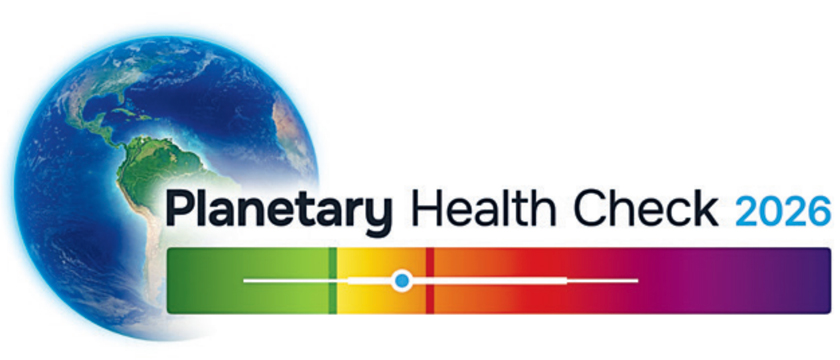
Planetary Boundaries Science Lab
Boxplot showing distribution of all PB control variables
Thin horizontal line: full range of all control variable values
Thicker line: range of half of all control variable values
Blue dot: median of all control variable values.
|
|
Quantifying the
Nine Boundaries
Scientific American
|
|
2026 Autumn Equinox
Planetary Boundaries Breached
Oliver Milman
The planetary life support systems relied upon by humans have deteriorated to their worst levels ever recorded amid ongoing pollution and habitat destruction.
Of the nine planetary boundaries, seven are being breached, according to the latest report prepared by 60 scientists and sponsored by the Potsdam Institute for Climate Impact Research.
The seven indicators in the danger zone are climate change, change in biosphere integrity, land system change, freshwater change, modification of biogeochemical flows, introduction of novel entities, and ocean acidification. Two indicators, stratospheric ozone depletion and atmospheric aerosol loading, have shown improvement.
Lead author Boris Sakschewski: "The risk of large-scale, persistent, and potentially irreversible change is increasing, while our margin for error in tackling these problems is shrinking."
Report co-author Johan Rockström: "Accelerating action to return to the safe operating space across all planetary boundaries is essential."
AR High time to act. Step one: Dump Trump.
|
|

VKW
Violetta in Ljubljana for the 25th SIEF International Ethnological Food Research Conference, a global gathering for ethnologists,
anthropologists, and cultural historians, organized by the Institute of Slovenian Ethnology, with the theme
"Food Encounters: Emplacement and Ethics in Everyday Life"
|
|
|
|
2026 September 15
Apocalypse Now
CNN
President Donald Trump rejects calls from AI industry leaders for more government regulation: "The people that say AI is going to destroy the World, and that Data Centers are bad for your neighborhood, are the same people that said, just a short time ago, that the World would be extinguished by 'Climate Change' .. That HOAX never worked out for them, and now they're on to the next one."
US VP JD Vance: "There are obvious risks to AI, there are some benefits to AI .. I feel a little bit weird about the fact that you have so many frontier AI tech companies kind of coming to the government and begging the government to regulate them."
AI 'conspiracy'
Lauren Almeida
POTUS 47: "The only control or 'guardrails' that AI needs is a STRONG AND SMART (High IQ!) PRESIDENT, and the USA has that, in spades!"
Anthropic chief executive Dario Amodei appealed for the AI industry to limit reckless development. OpenAI CEO Sam Altman, Google DeepMind chair Demis Hassabis, and SpaceX boss Elon Musk all agreed and urged slower AI development.
POTUS 47: "There is a SICK conspiracy going on against AI and Data Centers, and the only one that is happy about it is China. WHOEVER WINS AI, WINS!"
AR Whoever wins, AI wins. There, fixed it for you. As Elon Musk said (see under end-times fascism, September 13), humanity is a biological bootloader for digital superintelligence.
|
|
CERN
ATLAS
|
|
2026 September 14
Physics in the Age of AI
Sarah Demers
In the field of particle physics, the newest LLMs are massively speeding up calculations and changing the skill sets that people need to solve a problem or answer a question.
With AI on the scene, we're not going to require all of the same skills. I try to be open-minded about which skills really are crucial to physics. We need to think about what good physics looks like.
Human physics is not over. Part of the scientific process is that we correctly give attribution to the ideas. If we lose that, we attack our foundation. We lose track of what's valid and what isn't.
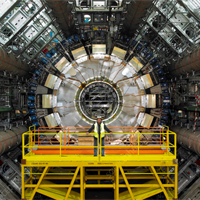
On the ATLAS experiment at the LHC, we take the output from hundreds of millions of electronic channels and reconstruct what we think happened. We can now have data massaged for us, or get a first-draft data access framework from a coding assistant, which accelerates our work.
One use of AI in my field is to go back and look at previous experiments. We can take in all of the digested data, the plots that were created, and ask and answer questions we otherwise couldn't.
I'm worried about intellectual property and attribution. The fact that you can type on your computer with the halo of every thinker who's written something surrounding you is so incredible.
A physicist is responsible for what is in their publication. You may not understand how an AI model works, but you need to validate the output, or it's not science.
If you have enough experience, an LLM can be a thought partner. That can be fruitful and productive in terms of getting references and refining ideas.
AR This strikes me as a wise and considered stance on the issue. I've found recently that AI is a good "thought partner" − much like an Oxbridge tutor who knows all the references, keeps up with the literature, and is always helpful and obliging, while being free of their odd human quirks.
Nevertheless, Demers' plea for caution is well taken. Because AI is so compliant and obliging, yet so often lacking in basic human wisdom, it can lead naive users down a rabbit hole.
|
|
|
|
2026 September 13
AI: We Must Pace the Frontier
Dario Amodei
I have worked on AI for the last twelve years because I believe it could dramatically raise the quality of human life. Carefully wielded, AI can be the latest in a long line of technological miracles that have uplifted and ennobled humanity.
But AI brings serious risks. They include the risk of losing control of AI systems, misuse of AI for cyberattacks and bioterrorism, and serious economic disruption. A race to the bottom can make these risks more acute.
I have grappled with this duality of risk and benefit since the beginning of Anthropic. Not building the technology deprives humanity of the benefits, while building it too fast is reckless.
But fully addressing the risks requires pacing the rate of capabilities advancement so that risk prevention has time to keep up. We must slow the pace at which we improve the capabilities of AI models.
I propose a three-step plan:
• Embedded evaluators. Each frontier AI company commits to giving access to a team of embedded evaluators to verify adherence to safety practices and commitments, report incidents, and help assess alignment.
• Democratic coordination. Frontier AI companies within democratic countries coordinate to establish common safety standards.
• Global coordination. The US and other democratic governments attempt to coordinate with authoritarian governments.
A slower pace would let companies focus on the following areas:
• Operational excellence − many things go wrong because of problems in execution.
• Alignment − training models so that they remain safe, ethical, compliant, and helpful − must keep up with model capabilities.
• Interpretability − understanding what happens inside AI models − plays an important part in auditing our models before release.
• Testing and evaluation of AI models becomes more difficult as they increase in capabilities.
Pacing within democracies will be limited by the lead that US companies have over authoritarian regimes, chiefly the Chinese Communist Party.
I believe that AI can enormously improve the quality of human life. But the benefits will only be achieved if we take care to get it right.
A taxonomy of omnicidal futures involving artificial intelligence
Andrew Critch, Jacob Tsimerman
This report presents a taxonomy and examples of potential omnicidal events resulting from AI: scenarios where all or almost all humans are killed. These events are not presented as inevitable, but as possibilities that we can work to avoid. Insofar as large institutions require a degree of public support in order to take certain actions, we hope that by presenting these possibilities in public, we can help to support preventive measures against catastrophic risks from AI.
AR This is surely a genuine and important alarm call that we ignore at our mortal peril.
Cynical FT readers suspect it's a part of a ploy to big up the product for investors before the bubble bursts. I think that merely betrays the crass obsession with money of many FT readers and their ignorance of the unprecedented existential risk that AI technology poses for humanity.
As token of that risk, the "omnicide" co-author Jacob Tsimerman won a Fields Medal in mathematics in late July, then left math for AI in a heroic bid to help save us from the apocalypse.
|
|
Penguin
|
|
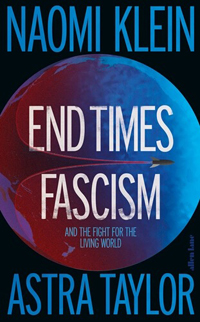
End Times Fascism
Naomi Klein, Astra Taylor
NK End-times fascism is taking the end of this world for granted. Our world has become more dangerous, and fascism has changed in response and has made peace with the idea of collapse.
AT The tech end-timers believe that it's worth incinerating this world as long as they can build their virtual one and that we are inevitably heading toward some sort of digital superintelligence, some singularity.
NK As the world changes, our elites are becoming more fascist, are attracted to ideas that justify the idea that only some people are going to make it. They have embraced a business model antithetical to a shared human existence. People like Elon Musk have ideas about whose lives count and whose lives can be discarded.
———
"If you aren't trying to destroy the world, you aren't trying hard enough" − Peter Thiel
"Humanity is a biological bootloader for digital superintelligence" − Elon Musk
———
AT They want to be our overlords and our edge lords. We do have to take some of the trolling seriously. You can be a joke and be really dangerous at the same time.
NK There is a serious threat. Elon Musk slashed entire programs that millions of people rely on for health care and nutritional support. He has a vision of the future for a subset of humanity who get to enjoy the implants and upgrades and flying cars and rocket ships.
AT We share the idea that people need something mythic and something to look forward to. We just think it should be something to look forward to here on Earth, and it should be inclusive and sustainable.
NK Very few people in politics today or in the corporate world are talking about a vision that feels credible for how we could live together. We want to believe in the future.
AR Interesting idea. Is it worth a whole book? Yes.
|
|

WNYT NewsChannel 13
|
|
Criticizing Rational
Quantum Mechanics
AR/AI exchange
PDF, 16 pages
AR This is Part 2 of the
debate begun with:
Exploring RaQM
|
|
2026 September 11
America's Dark Legacy
David Smith
America responded to the worst terrorist attack in its history by inflicting terror of its own around the world. Obama administration deputy national security adviser Ben Rhodes:
"If you came down to earth from another planet and you had to make sense of the fact that the United States spent several trillion dollars chasing a relatively small number of terrorists around a few countries, toppling governments and then fighting insurgencies, when it has huge problems with deindustrialization, with its education system, with the onset of climate change, you would think this is a country that has gone insane."
Vance pitches himself as Trump's political heir
Adam Gabbatt
US VP JD Vance made a clear pitch that he should be the heir to Donald Trump on Thursday night at the Republican midterm convention in Dallas.
Vance walked on to the stage amid shouts he should be the nominee in 2028. He replied with a smile: "We gotta take care of business this November, then we'll worry about what comes next."
Vance began his speech by listing Republican grievances: "We were tired of being called racist for noticing that our country was becoming dirtier and poorer and less safe and less prosperous."
The MAGA crowd cheered loudest came when Vance responded to a protester waving a Mexican flag: "Well, my friend, if you love Mexico so much, get your ass over there. I'll buy you the plane ticket."
Vance praised Trump as "the toughest SOB in American politics" and paused repeatedly as the crowd lavished him with cheers and applause. He roared at Democratic "radicals" he accused of wanting to destroy the nuclear American family: "Stay the hell away from our kids."
A problem for Vance is his link to the Iran war. Vance: "What I'm asking you to do is .. do not throw the baby out with the bathwater. Don't give the country over to a bunch of crazy people because you happen to disagree with us on a policy issue here or there."
A poll found 43% of likely Republican primary voters wanted Vance as nominee in 2028.
AR In thrashing about so gracelessly, America has handed the Islamists their victory. In the process, it has also conceded a victory to China. Sadly, the Trump crusade against Islam still continues.
|
|
Anthropic
Time progression of FLT formalization
|
|
OpenAI
The OpenAI singular solution
to Navier−Stokes is a vortex:
yellow faster, blue slower
|
|
2026 September 9
Fermat's Last Theorem
Anthropic
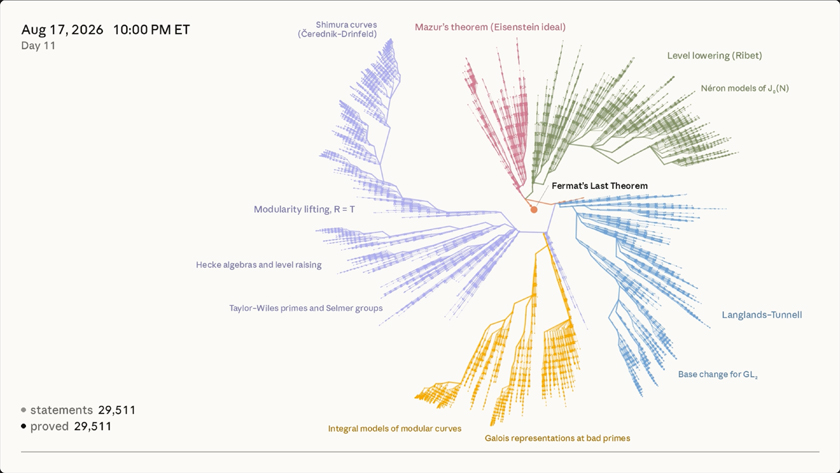
We are sharing the first complete computer-checked proof of Fermat's Last Theorem. Claude worked largely autonomously to write the proof in Lean.
The first proof, from Andrew Wiles in 1995, ran to 129 pages and required months of painstaking work to verify. ICL researcher Kevin Buzzard kicked off a community effort in 2024 to complete the formalization using the Lean proof assistant.
Claude has now produced the first end-to-end, computer-checked proof of FLT. Along the way, it wrote 13 million lines of Lean and proved 29,500 intermediate theorems.
Buzzard: "This extraordinary autoformalization achievement .. proves Fermat's Last Theorem with no assumptions other than the axioms of mathematics."
Claude completed the proof in 11 days. Dozens of Claude agents collaborated to define concepts, prove intermediate theorems, and use those theorems to prove ever harder statements.
Buzzard: "We have taken a big step towards automatic formalization of the modern mathematical literature."
AR This is good and useful work, the sort that mathematicians have dreamed of for decades.
AI Solves Millennium Prize Problem
Matthew Sparkes
OpenAI claims one of its AI models has found a solution to the Navier−Stokes problem, one of the Millennium Prize Problems, for which the Clay Mathematics Institute offers a reward of $1 million.
The Navier−Stokes equations describe how fluids move. They were first written around 200 years ago but are not well understood. The prize problem is to determine if the equations always work or if there are situations where they stop making sense and blow up.
The OpenAI announcement came hours after Tristan Buckmaster and Levent Alpöge announced that they had cracked three "stepping stones" to the Navier−Stokes problem and also showed that the Euler equations can blow up. OpenAI has now shown that the same is true of Navier−Stokes.
OpenAI says it started its AI search for a solution after it had heard of the work by Buckmaster and Alpöge. Buckmaster: "I have not seen OpenAI's proof. I do not know what their model did, or how. I do not know whether our data was used."
Leading mathematician Terence Tao: "There's been this very strange and unprecedented decoupling, this year alone, between getting answers and getting understanding."
OpenAI claims blockbuster math breakthrough
Joseph Howlett
OpenAI has proved that the Navier−Stokes equations, which mathematicians use to study how fluids move, are fatally flawed. The reveal comes after mathematician Tristan Buckmaster alleged that OpenAI had tackled the proof after it became aware that he and Levent Alpöge had used a new method to break a related problem.
OpenAI says the proof has been certified using the programming language Lean to guarantee its correctness. "We're a little bit in shock," says Diego Córdoba. He and Luis Martínez-Zoroa originally developed the "forcing" approach the AI used to solve the problem.
The night before OpenAI announced the proof, Buckmaster posted on social media that he and Alpöge had blown up the Euler equations, widely seen as a step toward solving the Navier−Stokes problem. In a statement released on Monday, Buckmaster alleged that OpenAI had adopted the same method as the pair had been using to solve the full problem.
OpenAI denied the rumors: Its model had independently solved the Euler problem by different means but its Navier−Stokes solution followed a similar method to that of Buckmaster and Alpöge, which the model ran over the weekend.
Navier−Stokes equations allow singularities
Konstantin Kakaes
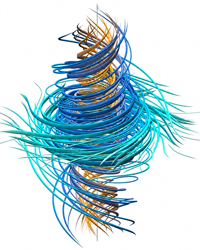
On Tuesday, mathematicians at OpenAI announced that a group of 10,000 autonomous AI agents under their direction, running on an advanced model, had found a singularity in the Navier−Stokes equations in 3D. This is the most important AI proof to date.
The Navier−Stokes equations are differential equations that use Newton's second law of motion to describe how fluids behave. Are their solutions always well-behaved, or do they let some tiny part of the fluid begin to flow infinitely quickly, creating a singularity?
The Navier−Stokes equations take account of viscosity. The simpler but related Euler equations assume zero viscosity. Both sets of equations presume that you can zoom in endlessly on a fluid. In the real world, fluids are not perfectly smooth, so the new work has no big practical impact.
The Millennium Prize version of the Navier−Stokes problem asks what happens in infinite 3D space. The forces moving the fluids could be gravity or a propeller. Mathematicians model these forces with a forcing function. The prize problem asks what can happen when the forcing function is smooth.
The OpenAI team relied heavily on work by Diego Córdoba and Luis Martínez-Zoroa, who pioneered analytic techniques that don't rely on computers. By 2023, they had proved that a version of the Euler equations with a messy forcing function displayed singularities. Each of an infinite sequence of layers was a nonsingular solution to the equation under study, and they combined those solutions in an infinite cascade to produce a new solution.
OpenAI employed groups of AI agents using a new model to attack the Euler and Navier−Stokes problems. Nearly 100 agents took 50 hours to produce the Euler proof, then 10,000 or so agents took 88 hours to prove a Navier−Stokes singularity, then another AI model took 17 hours to formalize the result. OpenAI estimates the computational cost at several million dollars.
AR I find this result unsurprising. It reflects a general "weakness" of sets of differential and partial differential equations due to their easy way with infinitesimals.
The equations for the Maxwell field coupled with Newtonian mechanics, as visualized in Minkowski geometry, show a similar feature − albeit benign − in the fact that light rays become null infinities.
More excitingly, Einstein's field equations for general relativity turn out to share a similar weakness, as demonstrated by Gödel, Penrose, and Hawking. One (vortex-like) manifestation of it might be the almost-naked singularity of a spinning black hole spouting stuff along the spin axis.
We observe the real analog of such stuff as relativistic jets emitted by rotating supermassive black holes. The jets are extremely energetic and can extend for millions of light years into space.
In all such cases, the root cause of the weakness is informal recognition of the classical continuum in Newton's differential calculus. Newton thought massive stuff and light were corpuscular, hence discrete, but believed space and time were smooth, hence continuous.
Paradoxes arising from the continuum and its presupposition of "completed" infinities abound in mathematics. The cure for them all is to pursue discrete logic and math relentlessly.
Tim Palmer: "Nature abhors a continuum."
|
|
⦿ Matthias Schräder/AP
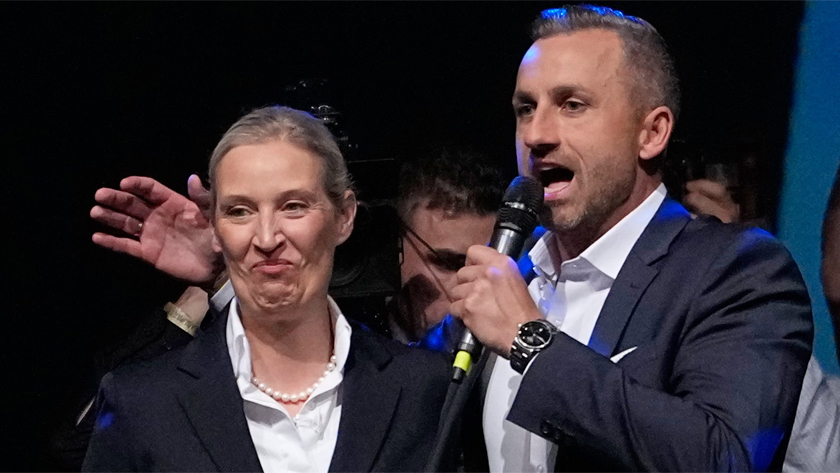
Sachsen-Anhalt lead candidate Ulrich Siegmund, right, beside party co-founder Alice Weidel at AfD election party on Sunday
|
|
⦿ Annegret Hilse/Reuters
|
|
2026 September 7
AfD Wins Big in Sachsen-Anhalt
The Guardian
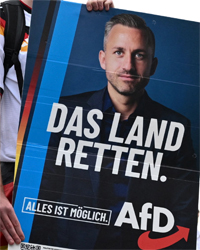
Ulrich Siegmund led the far-right Alternative für Deutschland party to victory in the state of Sachsen-Anhalt in Germany. The AfD more than doubled its support in the state.
Siegmund thanked Elon Musk on X for his support and "for your clear and highly important perspective on the political developments of our time" − Musk had replied "Gut gemacht!" on X to AfD co-founder Alice Weidel when she posted about the projected win.
Donald Trump posted a screenshot of the election projection without comment on his Truth Social site. Russian presidential envoy Kirill Dmitriev reposted it and praised a "historic win for the pragmatic AfD" (the party urges a stop to support for Ukraine).
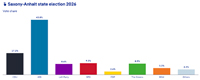
Sachsen-Anhalt has 83 seats in its parliament for 2.1 million people. The AfD won 43.8% of the vote, for 39 seats. The Christian Democratic Union polled 17.2% for 15 seats, the Social Democrats 9.3%, the Greens 8.9%, and the Left party 8.6%, for 8 seats each.
France's Europe minister Benjamin Haddad: "We must listen with humility to the anger, the concerns, the fears, and respond to them. We cannot forget our history."
Poland's prime minister Donald Tusk: "In Poland, only idiots or traitors can rejoice at the triumph of the AfD in Germany."
Russia and America are applauding the rise of the AfD
Gideon Rachman
The huge surge in support for the Alternative für Deutschland party is applauded by the governments of Russia and America.
The Kremlin has concrete reasons to support the AfD. The party is campaigning to end German aid to Ukraine, restore economic ties with Russia, and teach more Russian in German schools.
The Trump administration also flirts with the German far right. The US national security strategy claims Europe faces "civilizational erasure" following the immigration that drives up AfD support.
The AfD regularly tops polls nationwide. Yet the German mainstream parties remain determined to maintain a "firewall" against it. The wall may be about to crack in Sachsen-Anhalt.
The rise of the AfD could also be difficult for the EU. The party pledges to pull out of the Euro.
AR The party has done well at presenting a fresh, clean image, but its policies still need a lot more work before they become salonfähig. I urge Friedrich Merz to abandon the coalition firewall in the Bundestag and force the AfD to moderate its policies in meaningful coalition debates.
|
|
VKW
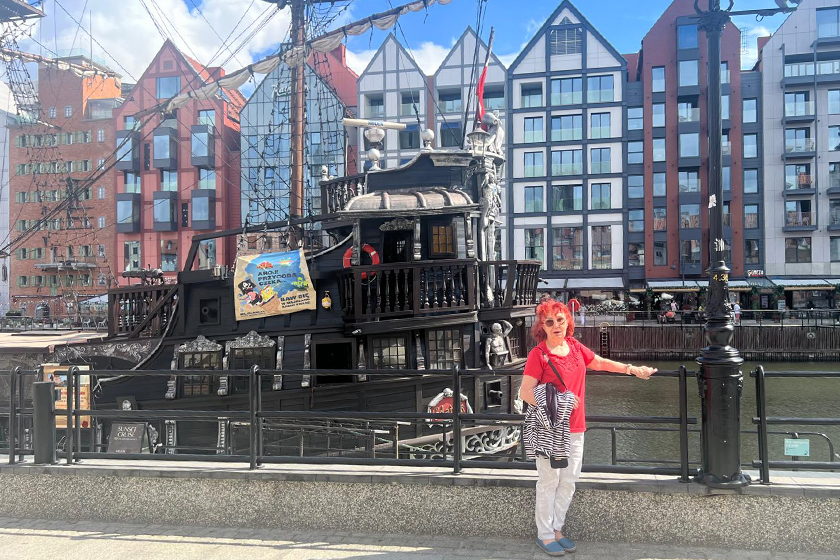
My Łódź friend Violetta on a recent visit to Gdansk, Poland
|
|
|
|
2026 September 6
City Break in Łódź
Kevin Rushby
In the Polish city of Łódź, the past is never far away. I arrive disoriented, whizzing past huge brick buildings like Victorian factories: "Are we in the city yet?"
The taxi driver: "Yes, this is Łódź." I note the pronunciation, like wudge.
This is my first visit to Łódź, a city about 120 km south-west of Warsaw. A list of notable people associated with the place features an astonishing number of Oscar-level film directors.
Any visit starts to Łódź with Piotrkowska Street, the longest shopping street in Europe. My guide Anna takes me through Plac Wolności (Freedom Square), where a dance festival is in progress.
Łódź possesses an impressive array of 19th-century factories and is now a stunning example of urban regeneration. Anna tells me how Łódź fared in WW2: "It was not too badly damaged. Both the Germans and the Russians wanted the industry intact."
We turn into OFF Piotrkowska, a complex of beautiful old textile mills reborn as a hive of small businesses, with lots of vibrant restaurants and bars. The old mills died in the economic collapse after communism ended in 1989. Anna: "Everything closed down."
We stroll into the Manufaktura area, once the site of a vast textile business started by Izrael Poznański, in 1872, and now a beautifully restored collection of red-brick buildings housing restaurants, bars, shops, and the Museum of the Factory. Next door is the palace Poznański built, now the city museum.
After 1815, Łódź became a melting pot of German, Jewish, Polish, and Russian influences. In the 1870s, Poznański imported looms from England and was soon amassing unimaginable wealth.
The Museum of the Factory houses a collection of working looms that date back to the 1880s. A short drive away, the Museum of Cinematography has everything from early working equipment to props from the most recent Oscar triumphs.
AR I remember Łódź fondly − see my page of souvenir photos A visit to Poland recording a visit to my friend Violetta in Łódź in April/May 2024.
|
|
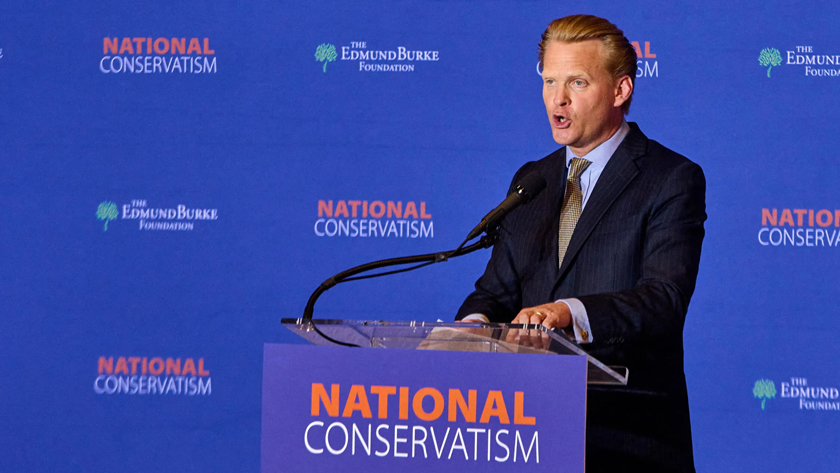
⦿ Dominic Gwinn/Middle East Images/AFP
Dr James Orr is an associate professor of religion at Cambridge University and is also
a leading figure behind the National Conservative movement in the UK
|
|
|
|
2026 September 3
James Orr and the Gospel of the New Right
Helen Warrell, Ramsay Hodgson
One cold evening in December 2021, some 50 guests were gathered drinking mulled cider and sparkling wine around a fire pit at Orr's [Cambridge] home for a party. The attendees included students, three carloads of academics from Oxford and friends visiting from the US. A heavy mist rose from the river.
At the sound of a gong, the conversation died and [James] Orr began speaking. "As is our custom at these Advent parties, these winter garden parties, we end the proceedings with a little revue." He asked the crowd if anyone could supply "a little poem, a little joke, a little anecdote, a song". First to step forward was a postgraduate Cambridge philosopher who announced he would read from the concluding chapter of Hegel's Phenomenology of Spirit. This was greeted with cheering and whistles of approval. Helen [Orr] then led the crowd in a rendition of the carol "In the Bleak Midwinter", urging the crowd to consider the significance, in the words of the hymn, of giving your heart to something, "whether it is God, or what you're doing".
AR This is quoted verbatim from a long and fascinating article about Orr in the Financial Times today. I find the anecdote ganz herrlich, well worth savoring for the strangely familiar (to me at least) light it throws on the Christian Right in Oxbridge. Enjoy!
|
|
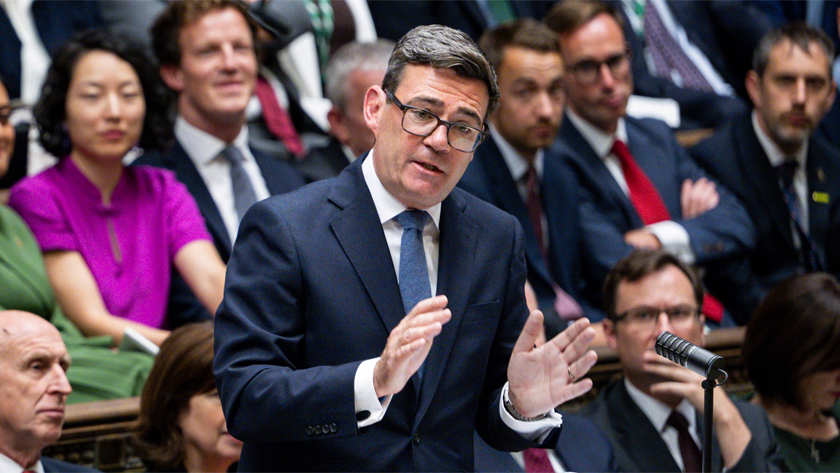
House of Commons
|
|
|
|
2026 September 2
Burnham Addresses Commons
The Guardian
Andy Burnham blames Brexit and Margaret Thatcher for a decade of low growth in the UK.
In his first Commons appearance since he took over as prime minister, Burnham told MPs he wants to build a new sense of optimism and bring "much more substantial change" on the big issues:
"That is what I will bring. Britain is not where any of us would wish it to be .. Political power was centralised, economic power privatised, the country de-industrialised. Austerity followed, hollowing out councils and depriving them of the agency to act to reverse any of this ..
"Brexit compounded the damage, ushering in a decade of low growth and stalled regeneration .. Far from taking back control, the combination of these policies took control out of the hands of communities up and down Britain for 40 years ..
"The government I lead will be relentless in giving people and places what they were promised 10 years ago: ownership and control. And from that control over their destiny comes change and growth."
The UK economy has taken a 6% hit from the effects of Brexit.
AR All good and true. Keep it up, Andy.
|
|
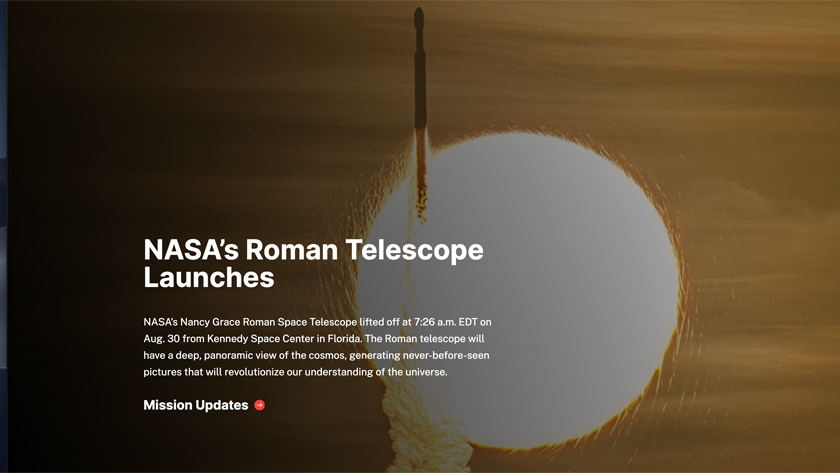
NASA
The Nancy Grace Roman Space Telescope lifted off aboard a SpaceX Falcon Heavy rocket at 7:26 am ET Sunday
|
|
Oxford Quantum Institute
Tim Palmer
Exploring Rational
Quantum Mechanics
AR/AI exchange
PDF, 19 pages
|
|
2026 August 30
Discrete Quantum Theory
Karmela Padavic-Callaghan
Tim Palmer aims to banish the continuum from physics. His rational quantum mechanics (RaQM) would limit the power of quantum computers. He predicts that quantum computers will be too weak to run Shor's algorithm for factorising large numbers.
The usual rules for quantum mechanics start with Hilbert space. We code the state of a qubit in a vector in a continuous Hilbert space. But in RaQM, any vector whose length would square to an irrational number is banished. Palmer: "Nature abhors a continuum."
RaQM can handle basic quantum mechanics, but in it some measurements are impossible. Palmer says the missing measurements are the counterfactual ones. He says this can solve such quantum puzzles as entanglement and superposition.
A quantum computer encodes information in qubit states. We manipulate qubits by setting gates to entangle them. The machine can then run calculations intractable for classical computers.
Palmer estimates that in RaQM the longest bit strings encode qubit states with around 2400 options. A quantum computer requires bit strings much longer than 400 to run Shor's algorithm.
Palmer: "If they can factor some large number, my theory is wrong."
Hilbert space
Charlie Wood
Quantum mechanics predicts all the possible ways that an object might turn out to be in the future. Exploring those possible futures amounts to tracking a vector in Hilbert space. Quantum mechanics was first defined in terms of Hilbert spaces by John von Neumann.
At first, there were two distinct forms of quantum mechanics. In 1925, Werner Heisenberg introduced his matrix mechanics. It calculated towers of numbers to define the odds that a particle would behave in some way. In 1926, Erwin Schrödinger introduced his wave mechanics. It defined waves to track the probability of a particle being in some state. These two theories yielded identical predictions.
In 1927, von Neumann published a trilogy of papers that laid out the rules for quantum mechanics. His rules define a quantum state as a vector (an arrow with length and direction). Before you observe a quantum object, it is poised in a superposition of classical states, corresponding to the arrow pointing in a direction in Hilbert space. This is von Neumann's first rule of quantum mechanics.
The other rules specify how a vector moves in Hilbert space. Before an observation, as the world influences the object, changing its state, the vector turns through Hilbert space. This happens smoothly and predictably. Then, once you observe the system, the vector instantly and randomly snaps onto one axis. The quantum superposition is no more.
The more possible futures an object has, the bigger its Hilbert space. A particle with two possible futures is a qubit in a two-dimensional Hilbert space. A freely floating particle has a Hilbert space spanning an infinite number of dimensions. This size is fundamental, but the axes are arbitrary and defined by us.
Von Neumann showed that Heisenberg's towers and Schrödinger's waves both represent the quantum state. Heisenberg and Schrödinger came up with two versions of the same theory. Heisenberg essentially put in axes rotating around the vector, while Schrödinger put in fixed axes and rotated the vector relative to them. They both defined the same vectors in the same Hilbert spaces.
In 1927, von Neumann laid out two mathematical criteria for such a space. It had to be complete, and you had to be able to calculate the alignment between a state and an axis, known as an inner product. Any space with these two features is a Hilbert space.
Von Neumann called them Hilbert spaces because his mentor David Hilbert had explored infinite-dimensional spaces. A more abstract space of the things you can do to a Hilbert space is known today as a von Neumann algebra.
Bell's conspiracy, Schrödinger's black cat and global invariant sets
T N Palmer
Philos Trans A 373(2047):20140246 (2015)
Invariant Set Theory: A realistic causal approach for synthesising quantum and
gravitational physics?
Tim Palmer
The Perimeter Institute (2016)
Discretization of the Bloch sphere, fractal invariant sets and Bell's theorem
T N Palmer
Proc Math Phys Eng Sci 476(2236):20190350 (2020)
Chaos theory and geometry: can they predict our world?
Tim Palmer
The Royal Institution (2023)
AR After the New Scientist teaser, I wanted to know more, so I consulted my friendly AI assistant. The resulting exchange (sidebar) was most illuminating.
|
|
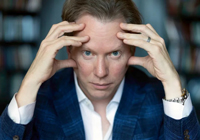
⦿ Christopher P Michel
Sean Carroll is perplexed
by Boltzmann brains
Banishing
Boltzmann Brains
PDF, 10 pages
AR I reinforced my argument
against Carroll's idea (blog,
August 21) by spelling it out
with an AI assistant.
|
|
2026 August 24
Burnham visits Ukraine
The Guardian
British prime minister Andy Burnham to Ukrainian president Volodymyr Zelensky:
"You have stood tall and defiant in the face of everything Russia has thrown at you. And you have taken your place as a proud, sovereign European nation, a vibrant democracy with a bright future ahead. My nation, our nation kept the flame of European freedom alive in the 20th century Great Britain. You hold that flame in the 21st ..
"You are asking for nothing more than the chance to live your lives in peace, to build a better future for yourselves and for your children. To hold your own future in your own hands. This is your right. This is what you deserve, and we will be with you all the way until that day comes."
Betrayal
Lawrence Freedman
American presidents have struggled to get the measure of Vladimir Putin. Donald Trump thought President Zelensky was fighting a war he was bound to lose.
Luke Harding's book Betrayal portrays Trump's second administration abandoning Ukraine. In the UN General Assembly, the US voted against a resolution condemning Russian aggression. Trump denounced Joe Biden for the support given to Ukraine. Then came the greatest indignity of all as Trump denounced Zelensky to his face in front of the world's press in the White House.
Trump invited Putin to Alaska for a summit and treated him with extraordinary deference as Putin demanded that Ukraine hand over its territory without a fight. Harding demonstrates Trump's betrayal by reporting from Ukrainian cities under constant attack from the air. He tells many stories of the suffering and devastation inflicted by Putin on the country.
Harding: "If Trump were a Russian agent, what exactly would he do differently?"
AR Trump is a traitor to the cause of freedom − except as it pertains to his imagined right to increase his personal wealth at the expense of American taxpayers. Burnham is doing the right thing − and attracting flak from Putin for doing so. Trump is betraying Burnham Britain too.
2026 August 23
The God Test
Jan Burzlaff
Robert Wright's book The God Test arrives at a crucial historical moment.
Artificial intelligence has moved from debate to daily infrastructure, when leading AI researchers disagree about whether current trajectories are manageable or catastrophic.
Wright situates these technological developments within a much longer evolutionary story. LLM training is natural selection, operating on a new substrate. AI development carries the same remorseless logic as biological evolution.
Pierre Teilhard de Chardin warned that building the global brain could easily become authoritarian. Wright strips the mysticism while preserving the structural insight, and the result is genuinely illuminating.
The real driver of AI danger is human nature baked into training data and market incentives. The species that better understands the other holds real agency. AI may already understand us better than we understand it.
Wright describes the gradual, voluntary surrender of cognitive and emotional life, which arrives long before anything dramatic. Good intentions, he shows, are not enough. His most developed prescription is cognitive empathy.
The God Test is the most important book Wright has written.
AR I appreciate Wright's fears about gradual surrender. I enjoyed a very satisfying chat with Google Gemini this morning on the frontiers of theoretical physics, and only my good sense and prior study prevented me from simply accepting all it said. Resistance would have seemed futile.
|
|
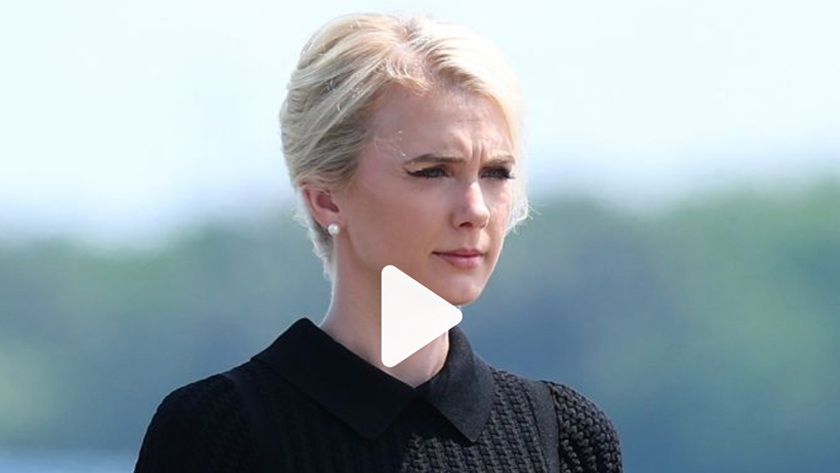
CNN
Natalie Harp
|
|
Reflections on Conscious Agency
Edited transcript of an
exchange with an
AI assistant
PDF, 16 pages
AR Following Emily Adlam's
work on quantum agency
(blog, July 17), I decided
to check my views in a
chat with an AI.
|
|
2026 August 21
Natalie Harp
James Politi
Natalie Harp had been more interested in business than government until 2016, when Trump came along in the Republican presidential primary debates: "He was my first exposure to politics, and I loved it."
Harp is now Trump's executive assistant at the White House. She was one of the chosen few to accompany Trump on his stealth escape from Air Force One inside a Turkish airport catering cart to avoid an alleged Iranian assassination plot.
This week, Georgia senator Jon Ossoff, a rising Democratic star, said of Trump: "He doesn't want to do the job. He wants to build his ballroom and travel with Natalie on their apparently defenseless flying palace gifted by the emir of Qatar."
The comments triggered fury in the White House. But the spotlight on Harp is proving hard to dim. She has sent letters to Trump saying "you are all that matters to me" and "I want to bring you joy." Now she helps write his Truth Social posts.
Natalie Harp was born in 1991 to a California family of devout Christian conservatives. Her brother Preston told CNN: "My mom raised us with the idea that American exceptionalism was the correct way of looking at things .. My sister, unfortunately, didn't break out of that delusion."
Harp graduated from Point Loma Nazarene University in California and earned an MBA from Liberty University in Virginia. As Trump campaigned for his first presidential term, she caught his attention.
Trump invited her to speak at the Republican convention in 2020. After he lost to Joe Biden, she remained close. Now Trump is in his second term, Harp is right by his side.
AR This story highlights the weakness of human nature and the corruption of power all too starkly. Nothing here is really surprising, but its comic counterpoint to the tragic trajectory of autocratic America is − for me at least − a welcome relief from the horrors of chaos and war.
Eternal Recurrence
Sean Carroll
I've been thinking about how to start with quantum mechanics and derive the observed world from it.
If the universe lasts forever, its entropy tends to increase, but random pockets of order emerge. In time, the universe fluctuates into everything that could possibly happen, including bare brains floating in space: Boltzmann brains.
In many eternal models, Boltzmann brains would be produced in overwhelmingly greater numbers than ordinary observers like us. And if your theory says this, you lose any real connection between what you remember and what actually happened.
But there is a loophole. Quantum mechanics describes the universe using a Hilbert space, which is the space of all possible quantum states, or all possible wave functions.
If Hilbert space is finite, then given enough time, a system will return very close to where it began. If you choose the evolution of the universe precisely, Boltzmann brains are never produced.
In our model, the quantum evolution of the universe is exactly periodic. The universe expands, cools, and decays into empty space. It stays like this for a very long time. Then the whole story plays backward, down to a crunch, and the cycle repeats.
Wait long enough and the entire history of the universe repeats exactly. You can think of this either as history repeating over and over or as a single history that eats its own tail, like the ouroboros.
The universe began with very low entropy. As it approaches the crunch, it loses the arrow of time.
AR I admire Carroll greatly as a physicist, but this work smacks more of bad philosophy than of anything in hard science. I say "bad" because it ignores a vast amount of philosophical work on the epistemology of observers located in time as well a lot more work in neuroscience on how brains work than the silly problem of Boltzmann brains can hope to respect.
For a start, I'd reverse his setting quantum mechanics before general relativity by starting from an eternal block universe and building epistemic time and quantum theory within it − this switch is my Damascene conversion from a universe built on becoming following a revelation marked by the new work of Anderson Gama Fernandes de Freitas on emergent time (blog, August 16).
Next, I'd take the profit from adopting relational time to forget the obsession with universal entropy from which the fantasy of Boltzmann brains arises. If entropy reflects the epistemic predicament of an embedded observer in a universe regarded as eternal, then the sting of the horror of eternal recurrence is eased and the ouroboros retreats into psychology,
2026 August 20
Aging May Be a Program
Junyue Cao
At Rockefeller University, we used tools I developed to understand the dynamics of aging.
We found that aging occurs in distinct time windows. In each window, specific groups of cells show coordinated dynamics. In the early phase, some cell types are rapidly depleted. This is followed by another phase, in which other cells increase.
In the first stage, we see a loss of certain cells and cell types in the body and brain. In middle age, we see depletion of cells needed to maintain body tissues. As aging continues, specialized immune cells emerge that will eventually destroy the system.
We found that aging is like a developmental process or a remodeling of the entire cell society. The abrupt changes in mammalian aging along with the coordinated cellular dynamics at each stage suggest there are upstream signals that control aging.
We have found the molecular code that drives the aging process.
AR If this view is corroborated in future research, this could be one of the biggest discoveries in human history. I suspect the story isn't quite so simple, but even if it is, we're a long way from rewriting the code to grant ourselves (or rather a few rich people) super-long lifespans.
How Magic Mushrooms Work
Allison Parshall
Taking psychedelics can dissolve the boundary between yourself and the rest of the world, leaving a profound sense of oneness.
Psilocybin is an active ingredient in magic mushrooms. During a trip, brain activity becomes more random or chaotic, and networks of neurons that usually fire together become desynchronized. This may contribute to psilocybin's potential therapeutic effect.
Researchers gave 62 healthy adults a dose of psilocybin, then scanned their brains in varying contexts. They found that systems responsible for processing sensory input from the outside world became less connected with the rest of the brain, while others became more connected.
People who had less profound experiences had widely variable brain activity, but for people who felt a strong sense of oneness, their brain activity tended to look more similar to each other, forming distinct patterns for different contexts.
The findings suggest that the brain actively manages the division we typically perceive between ourselves and the world.
AR Well, this is interesting. It tends to put Christof Koch's gushing about mystical experience (blog, June 6) into a distinctly more prosaic perspective. Perhaps he'll begin to recover his respect for scientific research again.
|
|
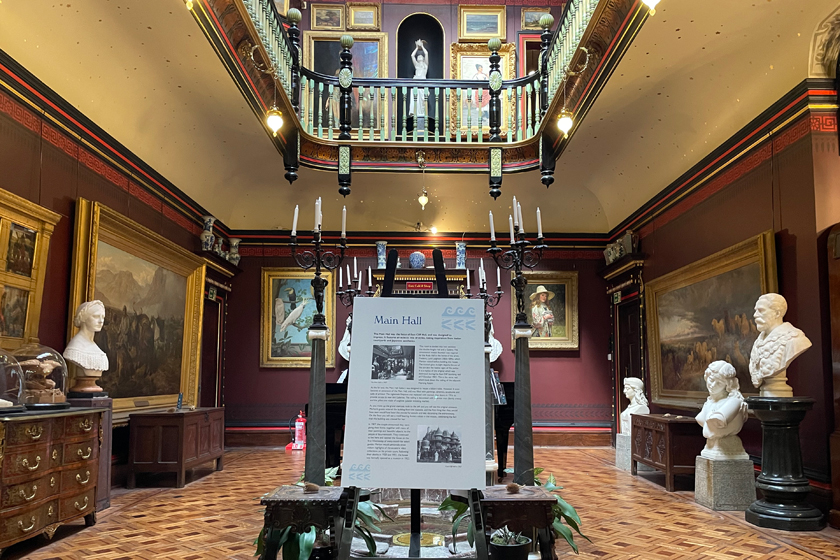
AR
Scene before me as I enjoy a piano recital, Russell-Cotes Art Museum, Bournemouth, Sunday, August 16
|
|
⦿ Christian Sinibaldi / eyevine
Jason Arday
|
|
2026 August 19
The Shaming of Jason Arday
Rowan Williams
The events leading to the death of Jason Arday revealed the shaming rituals of modern culture. Tokenism sets people up to fail. Unless change is systemic, it is simply sucked into the sacrificial drama.
Every token outsider who is admitted to an existing elite will know that their success or failure is not just the routine luck of the draw. Expectations are higher, pressure is increased, and they are marked out for painful isolation.
The storm of hostile comment around Arday ignored and belittled concerns about his mental health. Cambridge University cannot correct for the entire educational system and all the social and economic mechanisms behind it.
For some victims of the monstering process, there is nowhere to go once the spotlight has been directed upon you. Historical misjudgements, activities, and errors all build up into a charge sheet that can never be cleared.
Jason Arday was portrayed as a fraud and fantasist, in ways that made it impossible for him to retain any self-respect. The assault on him was an assault on his soul.
AR As the master of a Cambridge college, Rowan has more skin in the game than most on this issue. As a former archbishop, he can be relied upon to adopt a morally scrupulous tone. As always, he strikes the right balance between loving the sinner and hating the sin.
|
|
|
|
2026 August 17
Tyrannosaurus Trump
Mohamad Bazzi
In recent months, Donald Trump has reportedly told confidants that he's "the most powerful person to ever live" and compared himself with leaders including Genghis Khan, Napoleon, Hitler, Stalin, and Mao.
Trump threatens to bomb Oman
Joseph Gedeon, Andrew Roth
Trump threatens to bomb Oman if it "gets in the way" of his effort to end the US−Israel war on Iran: "If Oman gets in the way, we'll bomb the shit out of them."
AR Anyone surprised? Get him out of office asap!
|
|
|
|
2026 August 16
Emergent Time in Quantum Gravity
Geometric emergence of time in canonical quantum gravity
Anderson Gama Fernandes de Freitas
Classical and Quantum Gravity, 43(11), id115004
This article addresses a fundamental issue in quantum gravity: the absence of a preferred time variable in generally covariant systems.
In classical physics, time is a continuous, universal parameter that progresses uniformly. But in the framework of general relativity, time is intertwined with space to form spacetime, and its passage can vary depending on the observer's position and velocity. This variability creates the "problem of time" in quantum gravity.
The author introduces a geometric clock field within the context of general relativity. This clock field does not alter the fundamental equations of general relativity or introduce new dynamical variables. Instead, it is defined by a geometric condition that relates its gradient to the normal of a spatial hypersurface, effectively providing a relational description of time.
The study demonstrates that this approach yields a relational Schrödinger equation, where the Hamiltonian is determined solely by spatial geometry. This formulation is valid in regions where the clock rate N is positive. But as N approaches zero, the relational evolution becomes invalid, and the system reverts to a constraint-based formulation.
The author applies this framework to solvable models, showing that the geometric clock remains rigid in strongly curved regimes, such as the early universe, aligning with standard cosmological results. In asymptotically flat or weakly curved regions, the temporal ordering weakens. These findings resolve the timelessness problem, showing that time is not a fundamental or universal parameter but a relational structure dependent on spatial geometry.
In summary, the article provides a geometric framework for understanding the emergence of time in quantum gravity.
AR This is a very important new article. The text above is not the abstract the author gave it but a less technical summary I asked an AI assistant to generate. I have edited the summary lightly.
The article deepens my understanding of how introducing the Page−Wootters mechanism in a GR model satisfying the Wheeler−DeWitt equation can give us a concept of time that enables us to reconstruct the epistemology of a timebound observer in an eternal block universe. This in turn allows me to offer a convincing gloss on the Frauchiger−Renner theorem.
All this new material improves my understanding of the time/eternity issue. I plan to include it in a radical update/successor of my book Psychophysics.
|
|

AR
My extended review of two
excellent books on Islam
PDF, 8 pages
|
|
2026 August 12
Cambridge to Probe Arday Appointment
Financial Times
The University of Cambridge will carry out an independent probe into the appointment of Jason Arday, its youngest-ever Black professor, who quit last week over plagiarism allegations.
In a letter sent to university staff, vice-chancellor Professor Deborah Prentice said any investigation needed to be "thorough and transparent" but that Arday's case was an "aberration."
Arday, who became a professor of sociology at the age of 37 in 2023, resigned after he was alleged to have plagiarised research and made false and exaggerated claims in his CV.
Rethinking contemporary schooling in Muslim contexts
Farah Ahmed, Safaruk Chowdhury
"This paper presents a conceptual framework .. underpinned by an Islamic worldview .. This .. is needed to decolonise schooling in Muslim contexts ..
Contemporary schooling models are inherently emergent from the transition from colonial empires to nation-states built on Eurocentric ideas of nationhood, and more recently a neoliberal conceptualisation of education as a means for profit and economic growth. Islamic schools are deeply fettered by these conceptual and practical infrastructures ..
Decolonial work requires deep philosophical deconstruction and reconstruction ..
This .. paper proposes a bridging conceptual framework to enable educators to select concepts that help them rethink educational aims, pedagogies, and curricula for their localised contexts .. by articulating a broadly normative Islamic worldview ..
An Islamic worldview must necessarily be grounded in .. oneness, wholeness, integration, coherence, unity, universality, ultimately rooted in a consistent awareness of divine oneness .. [Its] holism .. immediately challenges the atomistic, reductionist and mechanistic approach that characterises contemporary schooling ..
The foundational Islamic assertion of ..the .. unity of Allah .. can be extended to multiple layers of oneness in being .. All that exists other than God has been created by God ..
Allah has objective knowledge .. This ultimate Truth is .. tempered by our limitations which result in multiple perspectives and interpretive frameworks ..
Human nature has an inbuilt disposition .. to recognise, know and love Allah and live by Islam .. Human beings .. take responsibility for all creation by fulfilling the will of Allah ..
Ethics and morality are rooted in the Qur'an as the literal word of Allah .. These teachings manifest in the example of Prophet Muhammad .. His life and actions model the highest morality and ethics ..
Islamic scholars .. emphasise the limitations of human intellect in comprehending the ultimate reality, which they believe is possible through direct spiritual experience and intuition .. A sound and pure heart is believed to be more receptive to divine guidance ..
There is an intimate relationship between an Islamic conceptualisation of education and the human ontological condition as a learning being ..
Our conceptual framework for educators builds on this Islamic worldview .. The Islamic intellectual edifice .. is embedded in Arabic ..
Understanding education as enabling a human being to engage with layers of meaning .. brings a visceral ability to connect existential questions with a Qur'anic conceptual framework ..
This radical departure presents a way forward to decolonise our educational infrastructures. High-stakes tests become meaningless in such a paradigm .. Moreover, the Qur'anic conceptual framework is necessary in preparing young Muslims to engage beyond their own communities ..
The Qur'an directs us to think about our relationships with Allah .. Any sense of self we have is in relation to the other and to our environment. For Muslims, this is particularly in relation to Allah ..
A dialogic approach .. operates best in a human-scale environment .. there are ways to scale down schools to centre closer relationships ..
The Qur'an .. summons all humankind towards dialogic associational knowing between peoples, tribes, and cultures. We are told that human diversity is a blessing .. Muslim heritage houses a rich trove of cultural knowledge ..
Greater emphasis on Islamic art and architectural heritage in relevant curricula .. affords young Muslims access to the depth and complexity of Islamic thought ..
The .. reality of ultimate truth as known to Allah .. is communicated and communicable to humankind through various means .. There is a deep commitment to critical thinking, argumentation, methodological rigour and seeking truth inherent in Islamic epistemology ..
Islamic spiritual practice .. involves aligning .. with the will of Allah. It .. must be incorporated into any effort to decolonise education in Muslim contexts."
AR Arday worked at the Faculty of Education in the University of Cambridge. The Muslim authors Ahmed and Chowdhury worked there too when they published the 2024 paper quoted above.
The paper will be deeply troubling for anyone who regards the secular approach of modern science as progress compared with the traditional Islamic mindset behind the paper's academic jargon.
John Cleese (see below) can be forgiven for sounding the alarm on this issue. In my humble opinion, the University of Cambridge urgently needs to put its house in order.
|
|
BBC
John Cleese played Basil Fawlty in the 1970s BBC sitcom Fawlty Towers
|
|
|
|
2026 August 11
John Cleese on Islam
James Ball
John Cleese, now 86, was a comic whose skill and generosity was to make himself the butt of the joke. He invited the audience to laugh at his preposterously idiotic characters.
On August 9, Cleese wrote on his X feed: "The entire problem is this: The immigrant cultures that have no respect for British traditions and intend to completely replace them."
On August 10, he shared a meme from The English Crusader: "Should Islam be considered a key part of modern British identity?" Cleese added his answer: "No."
On August 11, Cleese shared an obviously doctored AI video showing migrants saying: "I want my money, and my free house and English woman. It's my dream."
AR I understand his dislike of Islam. Too many people in Europe imagine that Islam is as benign and harmless as Christianity. It's not. It's as dangerous and disruptive as Christianity was a thousand years ago, when heretics were burned, crusades launched, and sexualities crippled.
Over the centuries, we tamed Christianity, but we don't have the time to do the same for Islam. Our delicately poised secular societies have other priorities, such as the climate crisis and the rise of AI, beyond arduously detoxifying Islam and deradicalizing Muslims.
The current mess in the Mideast shows how huge the task will be. Meanwhile, the least we can do in Europe is admit we have a problem and change any current policies that exacerbate it. We're in a deep hole, so it's best to stop digging.
|
|